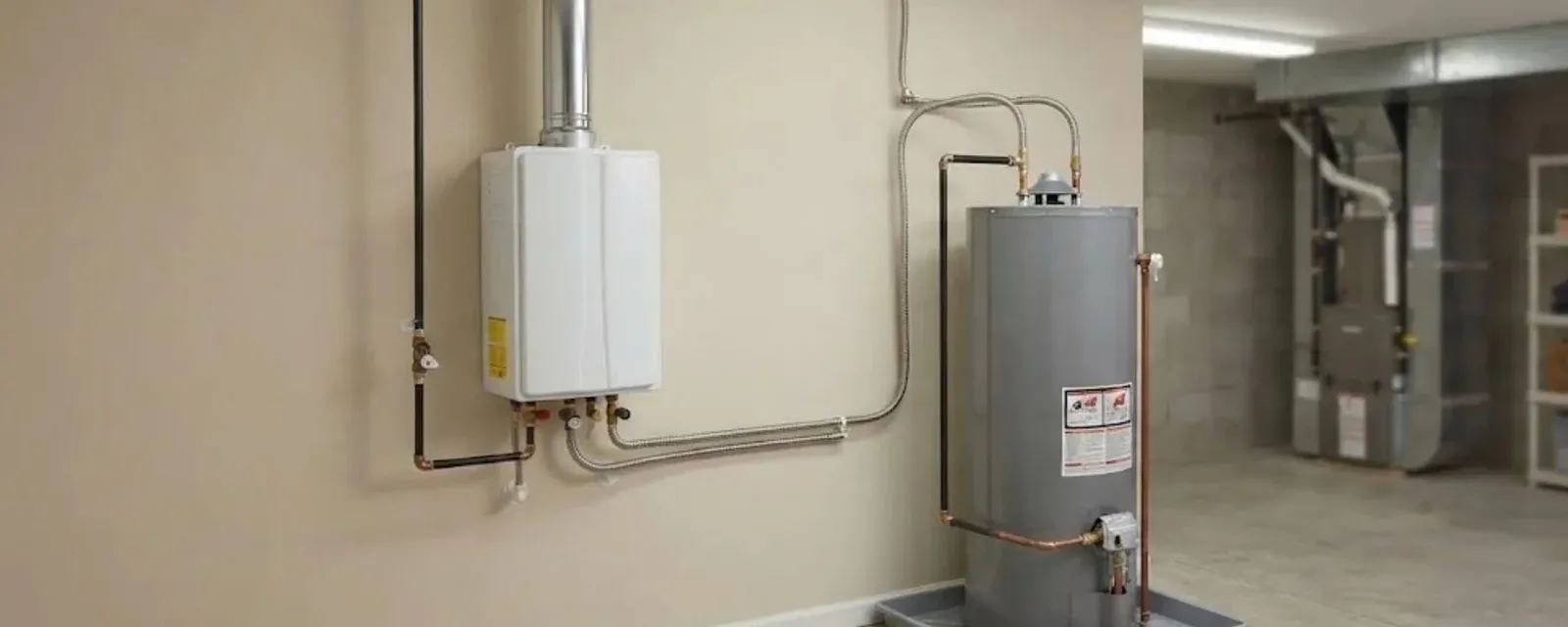
A tankless water heater heats water as it flows, which means minerals in the water bake onto the heat exchanger over time. That scale cuts flow, raises the temperature the unit has to reach and can trigger error codes. A vinegar flush dissolves it. Most homeowners can do the flush with a small pump, two hoses and a bucket.
Before you start, read your manual. Many units have service valves built in, and some manufacturers specify a product or a flush time. If the manual and this post disagree, follow the manual. Our tankless water heater service page is there if you would rather have a plumber do it.
Signs your tankless unit needs descaling
Hot water turns lukewarm
The exchanger is coated, so the unit cannot transfer heat as well as before.
Flow seems weaker
Scale narrows the passages inside the unit and the flow drops.
Error codes appear
Many units show a code when the exchanger overheats or flow is restricted.
Rumbling or popping
Water trapped under scale boils in small pockets and makes noise.
What you need before you start
- A small submersible or utility pump with hoses.
- A five gallon bucket.
- Two to three gallons of white distilled vinegar.
- Hose adapters that match your service valves.
- Gloves, eye protection and a towel.
- Your unit manual.
Use plain white vinegar, not cleaning vinegar with additives, unless your manual says otherwise. Pick a time when nobody needs hot water for an hour or two.
The flush, step by step
- 1
Power down.
Turn off the unit at the switch or breaker and close the gas valve if it is a gas model. Let it cool before you touch anything.
- 2
Close the water valves.
Shut the cold inlet and the hot outlet service valves. If your unit has no service valves, stop here and call a plumber to add them.
- 3
Connect the hoses.
Attach one hose from the pump to the cold service valve and another from the hot service valve back to the bucket. Open the purge caps to relieve pressure.
- 4
Circulate vinegar.
Pour vinegar into the bucket, start the pump and let it circulate through the unit for about an hour. Follow your manual if it gives a different time.
- 5
Rinse and restore.
Drain the vinegar, flush with clean water, close the purge caps, open the valves, check for leaks, then restore power and gas.
Safety points that matter
Never run the unit while the vinegar loop is connected. Keep the gas valve closed for the whole flush on a gas model. Vinegar smells strong, so open a window, and keep the bucket away from pets and children.
If you smell gas at any point, leave the building and call the gas utility or 911 before you do anything else. Do not use a phone or switch inside the house if you smell gas strongly.
How often to flush
There is no single schedule, because it depends on your water and how much hot water your household uses. Harder water scales faster. Your manual may suggest an interval, and many manufacturers recommend an annual flush in hard water areas.
A practical approach is to flush once, note how the unit performs afterward, and set a reminder for the same point next year. If the unit scales up quickly, a water test and a softener or filter may be the better long term fix.
When vinegar is not enough
Heavy scale, a leaking heat exchanger, a cracked part or a persistent error code after a flush mean the unit needs more than cleaning. Do not keep repeating the flush hoping for a different result.
At that point a technician can test the unit, check the venting and the gas supply, and tell you whether it is a repair or a replacement. See water heater repair for what that visit covers.
Always work according to the manufacturer manual, because code requires gas appliances to be installed and serviced following the maker instructions.
Tankless unit throwing codes?
Call the 24/7 line and tell us the brand and the code on the display.
Water in Cupertino and why it matters for tankless units
Water hardness varies by supplier and by source, so the right schedule for your home depends on your tap. Most of Cupertino is served by San Jose Water, and parts are served by other providers, so check your bill to see who supplies your address, then ask for the latest water quality report. Hardness numbers are in that report.
If you do not want to wait for a report, buy an inexpensive hardness test strip and test your tap. The result tells you how often to flush. Homes in Sunnyvale get water from a mix of sources, so the same advice applies there, and our Sunnyvale page has local notes.
Where we work
We dispatch from Cupertino and also serve Sunnyvale, Santa Clara, Saratoga and Los Altos. See the full service area and our tankless water heater page for more on this topic.
Tankless cleaning questions from Cupertino homeowners
Most manufacturers allow it, but some specify a product or a time. Check your manual first, and if the manual says to use a manufacturer cleaner, use that.
Yes. Without isolation valves you cannot connect the pump safely. A plumber can add them, and they make future flushes quick.
You should see better flow, steadier temperature and no recurring error codes. If the code returns within days, the cause is not scale alone.
Hardness depends on your supplier and your source water. Check the water quality report for your address or test your tap to get a real number.
Many homeowners do. If you are not comfortable with gas valves, hoses or the service valves, call a plumber, and never run the unit during the flush.
Turn off the water and the unit at once and call. A leak after a flush usually means a loose connection or a damaged valve, and a plumber can check it fast.