Water treatment is a planned job and it starts with a test, not a purchase. Homeowners in Cupertino, CA are served by San Jose Water and California Water Service depending on the street, and the water that reaches each tap is a blend of sources. Hardness varies with that blend, so a result from your own tap is the only reliable starting point.
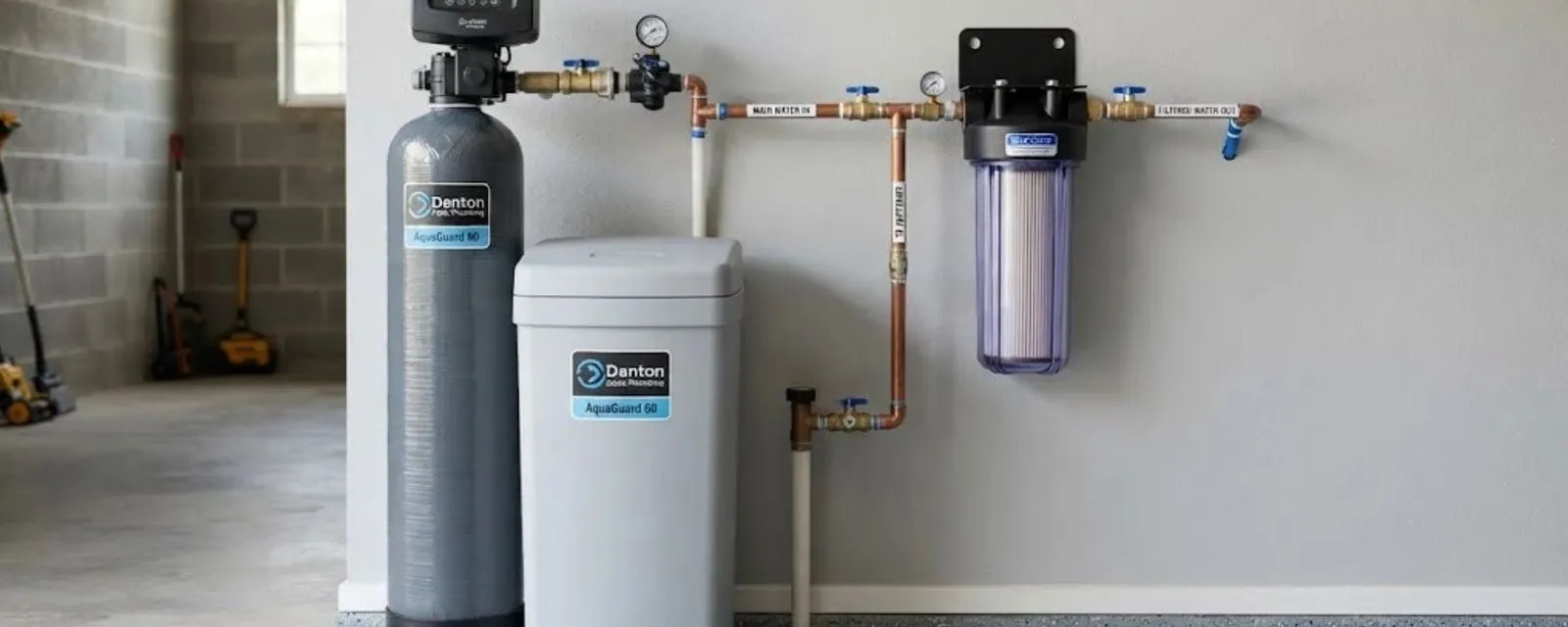
We install and repair water softeners and conditioners, whole-house sediment and carbon filters, and under-sink reverse osmosis systems. We schedule this work through the 24/7 line, and urgent leaks from a system are handled as plumbing emergencies.
What hardness looks like in this area
San Jose Water's published water quality report lists average hardness of about 99 parts per million, or roughly 5.8 grains per gallon, for treated Valley Water surface water. It lists about 288 parts per million, or roughly 16.8 grains per gallon, for groundwater, with a range from about 175 to 451. That is a report for the utility's sources, not a reading at your tap.
Your home may receive surface water, groundwater or a mix depending on your location and the season. Ask your provider for its latest annual water quality report, and test your tap with a kit or a lab before you size a softener.
Signs hard water may be affecting your home
White scale on fixtures
Chalky buildup on faucets and showerheads is a classic sign.
Spotted glassware
Dishes and glasses dry with spots even after the dishwasher.
Short heater life or low flow
Scale builds in the water heater and on aerators.
Dry skin and stiff laundry
Some people notice a difference after treatment, and others do not.
Softener, filter or both
| System | What it addresses | What it does not do |
|---|---|---|
| Salt-based softener. | Calcium and magnesium hardness. | Does not filter chlorine or particles. |
| Sediment filter. | Sand, silt and rust particles. | Does not soften. |
| Carbon filter. | Chlorine taste and odor, some chemicals. | Does not soften. |
| Reverse osmosis (under sink). | Drinking water quality at one tap. | Not for whole-house use. |
A softener will not remove everything, and a filter is not a softener. Matching the system to the result of your test avoids spending money on the wrong equipment. We explain the limits of each before we install.
Installation and drain requirements
A softener needs a place near the main water line, a drain for its regeneration cycle, power, and room for a salt tank. In a garage or utility closet this is straightforward. In a townhome it may need HOA approval for drain access.
The Cupertino Building Division lists plumbing permits for installation or replacement of plumbing, and we confirm whether a given system needs one. Some local jurisdictions regulate brine discharge, and we ask the sanitary provider where the question arises.
A softener drain line needs an air gap under the California Plumbing Code, which is based on the Uniform Plumbing Code (UPC), and local rules on brine discharge can apply, so ask your sanitary district.
Test first, then decide
Call to schedule a test, an install or a conditioner repair.
Service and repair of existing systems
A softener that runs out of salt too quickly, produces salty water, or no longer softens needs a look at the brine tank, the resin and the control valve. A filter housing that leaks or drops pressure needs a new cartridge or seal. We diagnose and repair these systems and replace them if they are beyond repair.
System type, capacity, location, drain and power needs, and permit fees set the price. We give a clear price before work starts. Filters and cartridges have ongoing replacement costs we explain up front.
If hardness shows up in a water heater, see water heater repair or tankless service. For neighbors in the next city, read about Sunnyvale.
Softener and filter questions in Cupertino
It depends on the hardness at your tap. San Jose Water reports lower hardness for surface water and higher hardness for groundwater, and your tap may be either or a blend. Test it before you decide.
Ask your water provider for its annual water quality report, and test your own tap with a home kit or a lab. The tap result is what matters for sizing.
A properly set softener adds a small amount of sodium and should not make water taste salty. A salty taste points to a setting or valve problem we can diagnose.
Often yes, but you need a drain for regeneration and may need HOA approval. We check before quoting.
Yes. We diagnose brine tanks, valves and resin and tell you whether repair or replacement makes sense.