
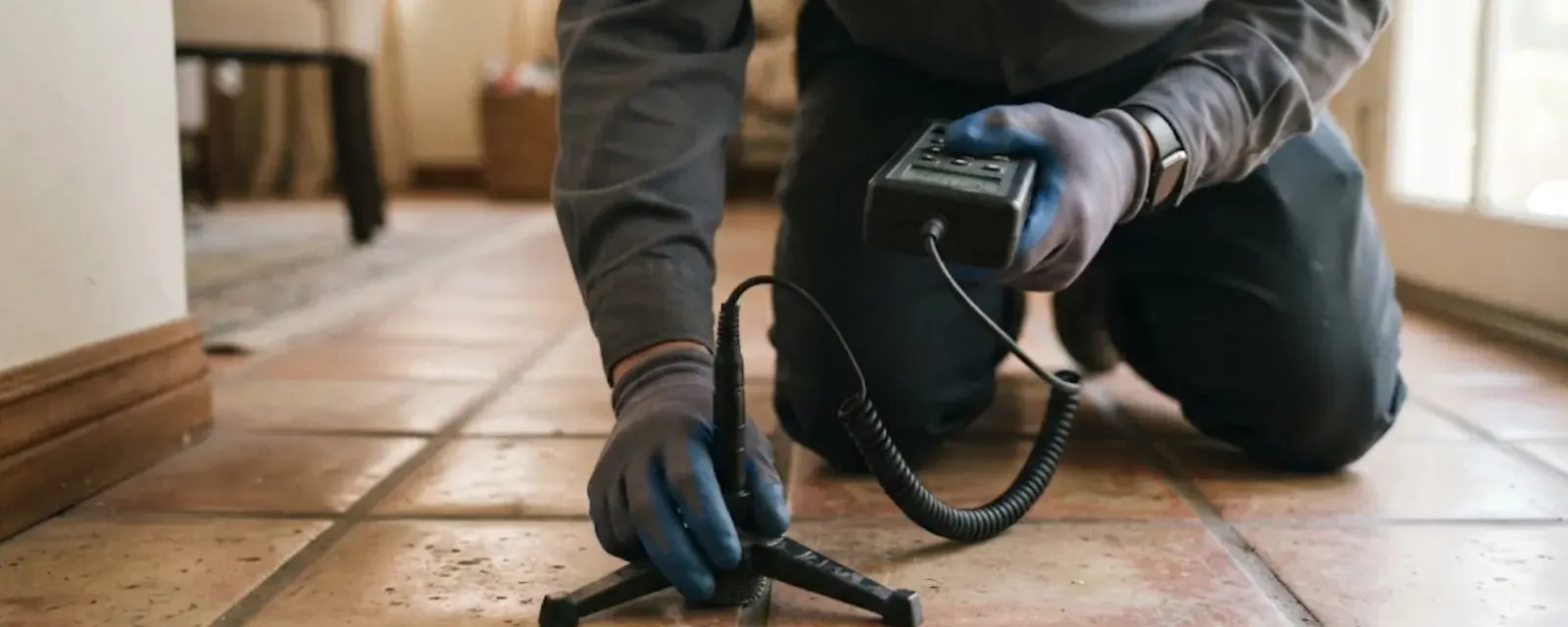
A hidden leak wastes water, raises your bill and can rot framing or feed mold without anyone noticing. The good news is that you can run several checks yourself in under an hour. They tell you whether a leak exists and roughly where it is.
If a check points to a leak you cannot find, our leak detection service uses listening and thermal tools to locate it without opening walls blindly.
The water meter test
This is the best first test. Turn off every tap, appliance and the ice maker. Then look at the meter. If the leak indicator spins or the numbers change while everything is off, water is escaping somewhere past the meter.
Write down the reading, wait an hour with the water off, and check again. A change confirms an active leak. If the reading holds, the leak may only show when pressure rises or when a fixture runs.
The toilet dye test
Toilets are the most common hidden leak. Remove the tank lid, add a few drops of food coloring to the tank and wait fifteen minutes without flushing. If color shows up in the bowl, the flapper is leaking.
A leaking flapper is cheap and quick to fix. See toilet repair if the problem returns or the fill valve is also failing.
Check the walls, floors and ceilings
Stains that grow
A brown ring on a ceiling that gets larger after use means active water.
Soft or warped flooring
Wood or laminate that lifts or feels spongy points to moisture below.
Peeling paint or bubbling drywall
Moisture behind the wall pushes the surface off.
Musty smell
A persistent smell with no visible source often means hidden damp.
Warm floor spots
A warm patch can point to a hot water line leak in the slab.
Hissing or dripping
Listen near walls and under sinks when the house is quiet.
Look under sinks and around appliances
Open every cabinet with a pipe. Check the supply lines, the shutoff valves and the trap for drips, rust or white mineral crust. Press a dry paper towel against each joint to catch slow seepage.
Look behind the washing machine, around the dishwasher and at the water heater drain. A small drip that runs for months can ruin a cabinet floor.
Outdoor and irrigation leaks
A soggy patch in the yard, a lawn that stays green in a dry week or a sprinkler zone that never stops can all point to a buried leak. Check the hose bibs and the irrigation valves as well.
If the meter moves with the house shut off and you find no indoor cause, the leak may be in the service line between the meter and the house. That repair needs a plumber with locating tools.
What to do if water is actively flowing
Close the main shutoff, open the lowest faucet to drain the lines and switch off power to any wet area. Photograph the damage for your insurance claim and call the 24/7 line.
When to stop guessing and call
If the meter moves and you cannot find the cause, call. If you see a growing stain, call. If the floor feels warm in one spot, call. Slab leaks in particular need proper tools, and you can read about them on our slab leak repair page.
Taking apart walls on a guess costs more than a locate. A good plumber finds the leak first, then opens the smallest hole needed.
Keep a simple record
Write down the meter reading at the same time each week for a month. Slow leaks hide inside normal use, and a record shows the trend. A reading that climbs faster than your habits explain is a reason to run the meter test again.
Photograph any stain with a coin or a tape measure for scale. When you call a plumber, those photos show how fast the damage is growing, and your insurer will want them too.
Seasonal checks that catch problems early
Check the water heater area, the washing machine hoses and the under sink supply lines twice a year. Rubber washing machine hoses wear out, and a burst hose floods a room fast. Braided steel hoses last longer, and shutting the washer valves when you travel is a cheap habit.
After a heavy rain, check the garage and crawlspace for damp spots, so you can tell a plumbing leak from groundwater. If you are not sure which it is, a plumber can test the lines.
Repairs to supply lines fall under the California Plumbing Code, which is based on the Uniform Plumbing Code (UPC), and a larger repair may need a permit.
Meter running with everything off?
Call the 24/7 line and tell us what you have already checked.
Water leaks in Cupertino and Santa Clara County
Most of Cupertino is supplied by a private water utility, and some parts have a different provider, so your meter and your bill come from whoever serves your address. Call the utility if your bill jumps, because many offer help checking for a leak on their side of the meter. Leaks past the meter are your responsibility.
Santa Clara County also lies in earthquake country, and shaking can loosen connections and crack old pipes. If your home has been through a strong quake, run the meter test afterward. For nearby Sunnyvale, our Sunnyvale page covers slab homes in more depth.
Where we work
We dispatch from Cupertino and also serve Sunnyvale, Santa Clara, Saratoga and Los Altos. See the full service area and our leak detection page for more on this topic.
Leak detection questions in Cupertino
Warm spots on the floor, the sound of running water with everything off and a meter that moves are the main signs. A plumber confirms it with listening equipment.
Coverage varies. Many policies cover sudden water damage and may not cover repair of the pipe itself. Photograph everything and ask your agent early.
Yes. A leaking flapper can waste a large amount of water without any sound. The dye test finds it.
The line from the meter to the house is generally the homeowner responsibility. Check with your water utility to confirm where its responsibility ends.
It is a reliable first check. It shows whether water is moving, but it does not tell you where the leak is.
Often yes. Listening devices, pressure tests and thermal imaging can narrow the location so the opening stays small.